Understanding Points of Contact
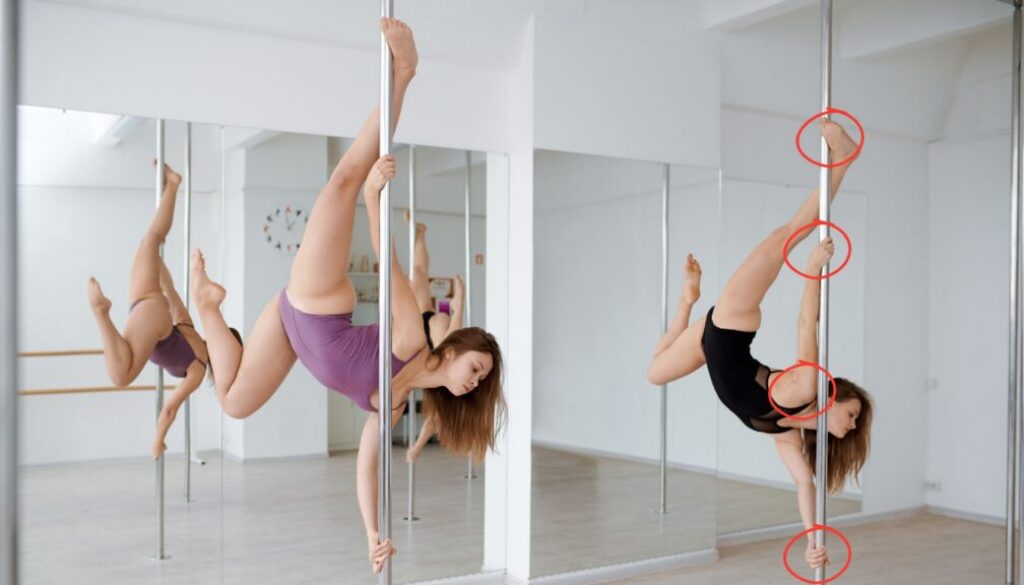
Points of Contact (or POC) refers to how many parts of your body are touching the pole at the same time, specifically while you’re inverted (hips above your head). The idea is to keep advanced moves out of lower-level divisions.
Tricks that use fewer points of contact (1 to 2) generally rely on a smaller support base, often just hands or one grip point. This makes them more advanced and riskier, and generally not appropriate for beginner to intermediate athletes. These rules give judges a baseline for comparison and help keep competition fair.
Basically, points of contact means the athlete needs to maintain some kind of grip or skin contact with the apparatus at three different anatomical points.
How it’s typically applied
A common version of the rule (used by orgs like the Pole Sport Organization) requires 3 points of contact whenever a competitor is inverted at an intermediate level. For example:
- A standard shoulder mount counts as 3 points of contact (2 hands + 1 shoulder).
- Moves like a Gemini/outside leg hang or a Scorpio/inside leg hang would qualify, since multiple body parts are bearing weight.
- Moves like an Iron X, Cocoon, or most Ayesha variations would not qualify as they rely on far fewer contact points and are considered too advanced for lower divisions.
The rule usually only applies when hips are above the head. It doesn’t apply to things like elbow stands, handstands, or descending into an invert where the hips stay below the head.
Why it matters for organizers and judges
It’s essentially a safety and fairness mechanism. It keeps divisions honest by preventing beginners or intermediates from sneaking in high difficulty, high risk moves that technically fit the invert rule but exceed the skill level the category is meant for.
Note that the exact threshold (3 points, which moves qualify, etc.) varies by competition. Some organizations don’t use this exact framework at all and instead rely on move specific banned and allowed lists by level.