Know Your Governing Bodies: Meet the Organizations Shaping the Future of Pole and Aerial
Meet the Federations Helping Shape the future of our sport.
Our sport doesn’t have just one rulebook. It has more than we can count, each one created by and unique to the competition that wrote it. With hundreds of pole and aerial competitions around the world, there are just as many sets of rules. But five organizations are stepping up to lead our sport into its next chapter, and, one day, hopefully, to the Olympics. So who are these organizations and what do they actually do?
Important Note: There is no single official governing body for pole and aerial yet. Several independent organizations are working to set standards for the sport, and each has its own rules, vision and structure.
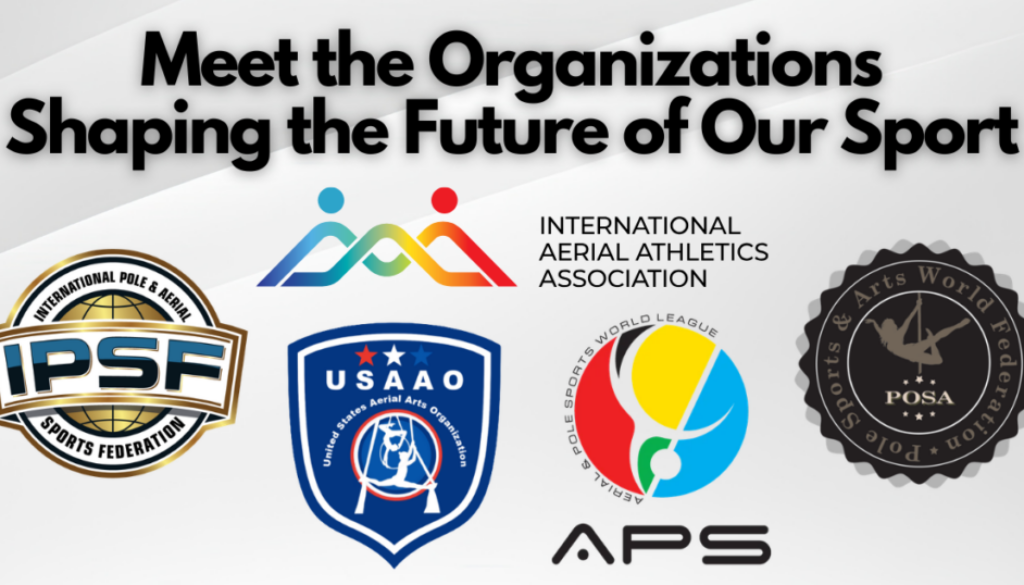
The 5, most commonly known as their acronyms (APSWL, IAAA, IAAO, IPSF and POSA) are:
- Aerial and Pole Sports World League (APSWL)
- International Aerial Athletics Association (IAAA)
- International Aerial Arts Organization (IAAO)
- The International Pole and Aerial Sports Federation (IPSF)
- Pole Sports and Arts World Federation (POSA)
These organizations or “governing bodies” have created their own competitive eco-systems with National federations and competitions in multiple countries that all share the same rules, regulations and judging standards. Behind the scenes, they employ technical teams to do the detailed work, like defining which skills are allowed and training judges to score them consistently. These teams are typically made of up coaches, current and retired athletes and studio owners.
What governing bodies usually do
- Write the rules and scoring system (the code of points)
- Set safety standards and eligibility, like age, level and attire
- Organize or sanction competitions and championships
- Train and certify judges, and sometimes coaches
- Rank athletes and recognize results
- Represent the sport to the public, sponsors and, for some sports, the Olympics and their in-country olympic councils.
The hope is that their work will grow into a unified set of standards, so every future studio, competition and athlete has a clear path to follow – and that leads to the Olympics like other recognized sports. Think USA Gymnastics: one recognized structure, with consistent rules, scoring and judging.
IPSF and POSA are among the most established names in our sport. Fun fact: they share a history, having originally been a single organization before becoming two.
At this time, it is unclear which organization (one of these five or maybe a newcomer all together?) will emerge as the primary governing body and authority for our sport. The hope is that, one day, our community will unify around a single universal standard that brings more consistency and clarity to athletes and coaches, while helping drive our sport forward to gain that Olympic recognition.
So why is it important to know these organizations? As an athlete competing under their system (or a coach prepping athletes) you need to understand their individual rules and judging system – even more so if you’re an athlete that competes at a variety of competitions not governed by the same organization.
While they all share some of the same basic principles and categorizations of ages and levels, there is a lot of nuance within them as you’ll notice in their Code of Points. These differences impact the way you build your performances (what tricks you can do in each level, trick valuation, deductions, etc), the documentation you must submit (ex: difficulty sheets versus compulsory forms and technical bonus forms), and the way that you are judged – including the make up of your jury at competition. As an athlete and coach, it is your responsibility to know and understand the code of points and rules for the competition you are entering. And as a new athlete it is important that you study these organizations and their rules before you decide to compete at one of their events.
Have questions about governing bodies, code or points or anything else competition related? Let us know!