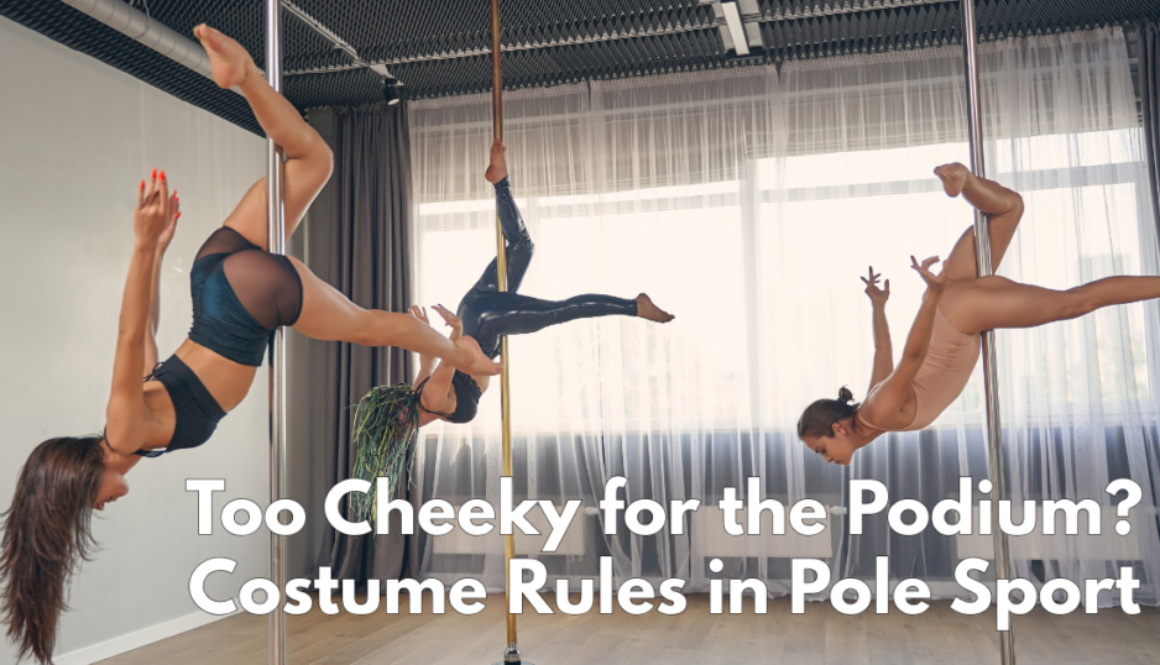
Too Cheeky for the Podium? Costume Rules in Pole Sport
If you’ve been on social media or keeping up with competition chatter recently, you’ve likely seen the outrage over an elite athlete being stripped of her medal because her costume exposed “too much booty.”
While the disqualification sparked instant debate, the core issue isn’t just the rule itself, it’s the maddening inconsistency with which it’s enforced year to year.
This isn’t a new conversation. It’s a recurring battle without an acceptable solution, saddling athletes with costume restrictions far stricter than those in comparable women’s sports. But if you look beneath the surface, the problem runs much deeper than fabric coverage. It sits at the intersection of body diversity, the ongoing policing of women’s bodies, and the sport’s lingering anxiety over its undeniable origins in strip clubs.
The Formal Precedent: IPSF, POSA, and the Push for “Sportification”
While the recent controversy erupted at a regional championship, the broader framework for these strict coverage mandates is heavily influenced by international elite federations.
In competitive pole, the gluteal fold debate centers on strict costume guidelines surrounding coverage of the lower buttocks (specifically the fold where the buttock meets the upper thigh) and how those rules are defined, judged, and enforced.
As elite organizations like the International Pole Sports Federation (IPSF) and the Pole Sports & Arts World Federation (POSA) have pushed for official recognition from global authorities (like the International Olympic Committee and GAISF/SportAccord), they established stringent costume codes. The goal was to distance competitive pole from its adult entertainment roots and force it into the visual mold of traditional disciplines like gymnastics or figure skating.
While local and independent competitions like The West Australian Pole Championship operate under their own specific rulebooks, this top-down push for “sportification” has trickled down across the globe, creating a culture where judging panels hyper-focus on costume compliance. But in doing so, organizers have adopted a rule set that clashes directly with human movement, biomechanics, and anatomical reality.
Double Standards Across Women’s Sports
To understand how extreme these attire demands are, you only have to look at how other elite sports regulate women’s bodies.
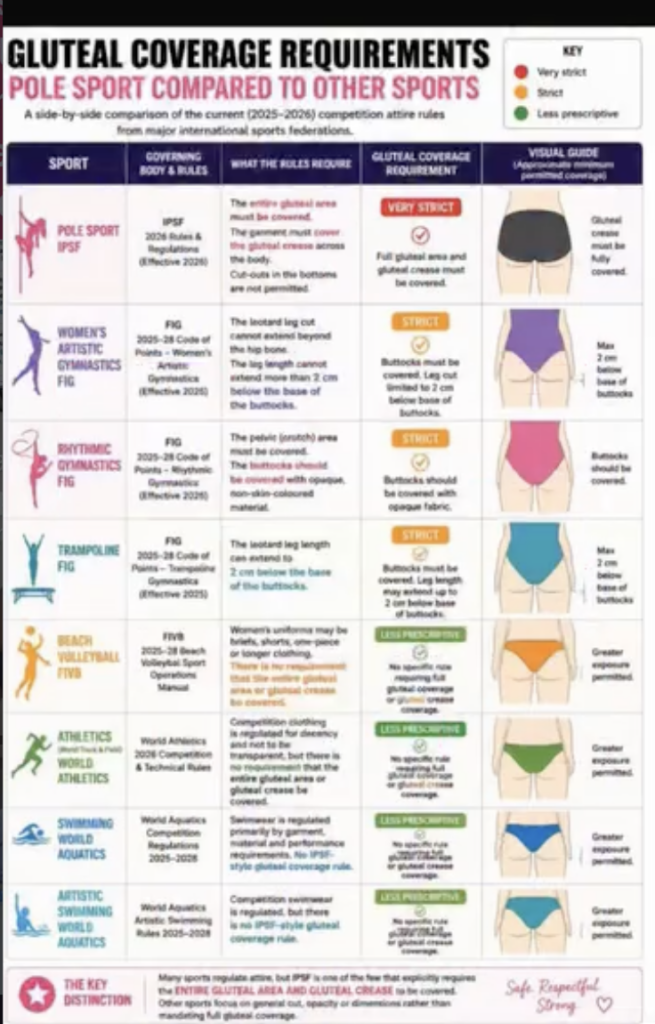
(Photo shared from kathangingout)
While federations like World Athletics, World Aquatics, and FIVB (Beach Volleyball) maintain less prescriptive rules that allow for greater skin exposure and natural movement, pole sport stands apart with an explicit, zero-tolerance policy on the gluteal crease. Even Artistic Gymnastics and Trampoline (under FIG) permit cutouts and higher leg lines down to specific centimeter measurements.
Many pole sport competitions, uniquely, mandates that the entire gluteal area and crease be fully covered at all times. This is a rule almost impossible to maintain while performing high-level aerial acrobatics.
Biomechanical Reality vs. The Strict Technical Rule
- The Strict Technical Rule: Competition codes typically dictate that bottoms must cover the pelvic area fully and 100% of the buttocks (or at least 3/4 depending on the division), explicitly forbidding any exposure of the gluteal fold or cleft. Judges assess point deductions or retroactively apply disqualifications for “costume malfunctions” or “indecency” if a costume shifts during inversions, dynamic drops, or splits.
- The Biomechanical & Grip Reality: Pole athletes rely on direct skin-to-pole friction, specifically in the hip crease, upper thigh, and under-butt area, to perform high-level tricks like dynamic drops, brass monkeys, or dangerous release moves safely. Standard athletic bottoms naturally shift during extreme flexibility movements like 180°+ oversplits or deep backbends. Requiring full gluteal fold coverage creates a genuine safety hazard if fabric ends up covering key grip points on the upper thigh, or if a costume rolls up mid-routine and triggers an automatic deduction.
Body Diversity and the “Over-Policing” Problem
The biggest flaw in the gluteal fold mandate is that it assumes every athlete’s body is built identically.
What looks like “full coverage” on an athlete with smaller glutes or a flatter hip structure may expose a gluteal fold on an athlete with larger glutes, a higher hip crease, or a curvier anatomical build – even if both competitors wear the exact same costume cut.
This creates a system where athletes are effectively penalized for their natural anatomy. When combined with the heightened scrutiny female-presenting athletes face compared to male competitors, the rule ceases to feel like an athletic standard and begins to look like the systemic over-policing and sexualization of women’s bodies.
Where Do We Go From Here?
Proponents often argue that strict boundaries are necessary to maintain modesty, attract mainstream sponsors, and gain broad acceptance. But when compared to elite sports like beach volleyball, track and field, or artistic swimming, all of which have achieved global recognition, major corporate backing, and Olympic status without forcing full gluteal coverage, it makes you wonder: is this level of modesty really necessary at all?
The evidence suggests it isn’t. Instead, sanitizing the sport to this degree forces athletes to prioritize costume management over technical execution, safety, and artistic flow. It signals that federations are still operating from a place of anxiety, attempting to police away the sport’s origins rather than trusting the extraordinary athleticism on display.
Progress is possible when federations prioritize athletes over optics. Organizations like Pole Sport Organization (PSO) have already embraced a “Free the Cheeks” approach by updating their guidelines to allow natural gluteal fold exposure and focusing on public decency rather than policing anatomical shape, all while respecting venue-specific requirements.
Whether at an international world championship or a regional event like The West Australian Pole Championship, stripping an athlete of an award over minor fabric movement shifts the focus away from athleticism and artistic achievement. A rule that punishes natural movement, discriminates against body diversity, and prioritizes arbitrary optics over athlete safety is not a standard of excellence, it is a barrier to progress. Until more competition organizers and federations align their uniform codes with the physical realities of the sport and the diverse bodies of the athletes who perform it, this debate will continue to shadow the podium.
Continue following the conversation with