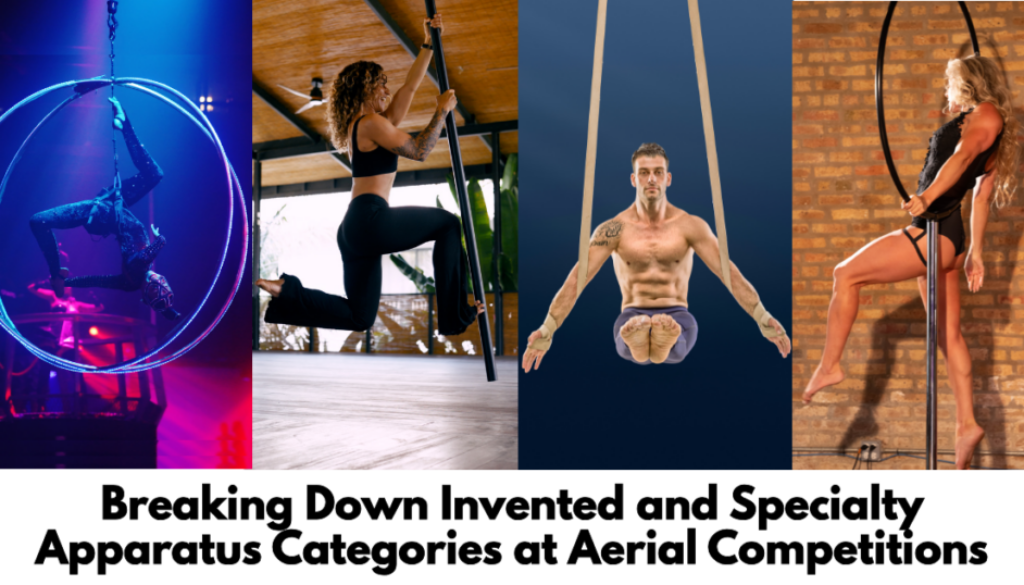
Breaking Down Invented and Specialty Apparatus Categories at Aerial Competitions
As you explore aerial competitions, you may come across categories like Specialty or Invented Apparatus and wonder exactly what they are. These are what we like to call “catchall” categories. They group a variety of apparatuses together under one broader category, governed by rules general enough to apply across all of them while still being fairly and consistently judged.
If you’re looking to compete on an apparatus other than pole, lyra, silks, or hammock, keep reading. This applies to you. Below, we break down everything you need to know about this catchall category, including its pros and cons.
Why Aerial Competitions Have Specialty and Invented Apparatus Categories
Every competition builds its rules, requirements, scoresheets, and judging criteria around a set of standard categories. This varies from competition to competition, but most often we see pole, silks, hammock, and lyra as the headlining categories. These are also the apparatuses most commonly taught at studios and covered in teacher training programs, so it makes sense that they’d be the first represented at competition. Their rules and definitions are written specifically around the tricks, movement demands, and creative potential unique to each apparatus.
But if you’ve been in the aerial world for a while, or spent any time scrolling aerial arts on social media, you know there’s a whole world of other incredible apparatus disciplines out there. Think flying pole, cube, aerial moon, tippy lyra, aerial triangle, stacked lyras, trapeze, rope, cloud swing, aerial net hammock, lollipop lyra, chains, and spiral.
The challenge with these apparatuses is that they’re often too varied or niche to justify their own dedicated competition category, and it can even be difficult to find specific classes or coaches for them. As a result, specialty apparatuses tend to draw very limited participation at competitions, often in the low single digits, sometimes just one athlete.
How to Compete on an Apparatus Without Its Own Category
So how do you compete on an apparatus that doesn’t have a dedicated category? You look for a competition that offers a Specialty or Invented Apparatus category.
Competitions add these categories to give athletes in less common disciplines a chance to compete. They’re often experimental in nature, meant to gauge interest and start building rules specific to that apparatus. With enough interest and participation over time, a specialty or invented apparatus can eventually grow into its own dedicated category.
Pros of Competing in a Specialty or Invented Apparatus Category
- The opportunity to perform your preferred apparatus on a competition stage
- A chance to do, and watch, apparatuses that otherwise likely wouldn’t make it into competition at all
- Can open the door for an apparatus to eventually earn its own dedicated category
- Helps competitions develop and refine judging criteria specific to that apparatus
- A great way to gauge interest as a discipline grows
- A great way to build awareness and interest in these apparatuses
Cons of Competing in a Specialty or Invented Apparatus Category
- All apparatuses get lumped together, which can skew judging due to generalized rules and a lack of comparable competitors
- Low participation means that whether you place or not, you’re not competing against a deep, competitive field, making it harder to gauge your standing
- Comparing different apparatuses against one another can skew scoring and results, since apparatuses differ so much in movement, capability, and handling
The Bottom Line
Specialty and Invented Apparatus categories exist to give athletes on niche or emerging apparatuses a place to compete, and to help those disciplines grow toward becoming standalone categories. They come with real trade offs in judging consistency and competitive depth, but for many athletes, the chance to perform on their apparatus of choice makes it well worth entering.